
Words matter, excuses do not.
Anti-Indigenous terminology is all around us and, confoundingly, it conspires simultaneously to engage in Indigenous erasure. These dual mechanisms are locked in a quantum reality wherein grown people, who have gone to school, say offensive, insidious or problematic things about Indigenous people precisely because they’ve been told that Indigenous people in the United States and its colonies no longer exist, or that they were the losing party in a war of equals.
The precise words to use in these cases are: genocide, land theft, and massacre.
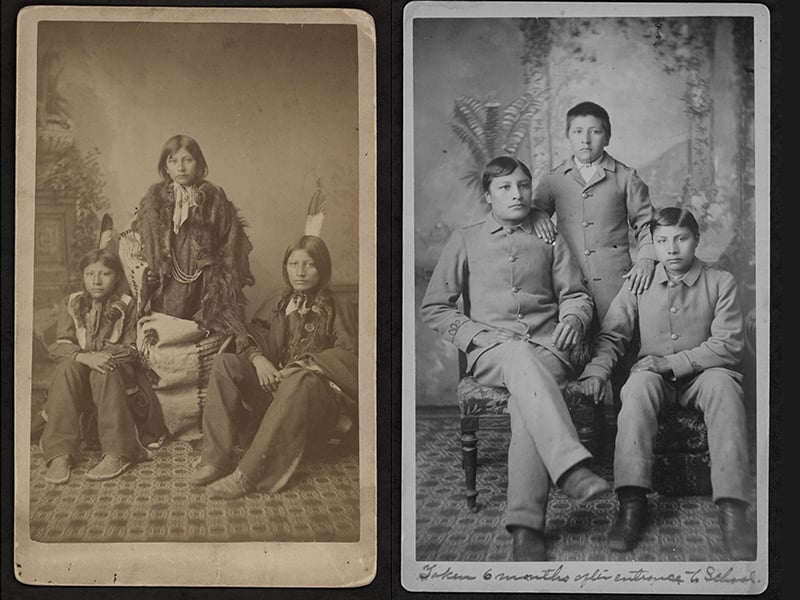
Indigenous people fought against the settlers of the United States and its Army not because we feared change and growth, but because almost every land transaction was a result of a treaty that was broken. Sometimes the reasons for breaking these treaties were understandable, but most of the time, they were about greed and a lack of innovation to grow within the existing boundaries of the United States.
Tribal nations were not hapless victims, either, but they had the deck stacked against them by a young nation that knew that to lie effectively, they had to put layers of bureaucracy between each other.
Every few years, someone in the public spotlight will say something offensive, problematic, or insidious about Indigenous people. This guide is offered as a method to educate oneself before such things happen.
OFFENSIVE
The following words and phrases are considered offensive by most Indigenous people. Of course, there will always be strangers on the Internet who claim distant Indigenous ancestry or who may even come from an Indigenous community who claim not to be offended. But by-and-large, these terms will result in most Indigenous people knowing not to trust you (at best) and calling you out (at worst). This category exists so you know what not to say. It’s recommended to use alternative phrases that are as descriptor-heavy as possible.

All Indigenous mascots
All Indigenous mascots: all team mascots that use Indigenous identity, no matter how much consultation has been done, are considered offensive. The Not Your Mascot movement (aligned with multiple, national, regional, and local Indigenous groups) advocates for awareness around the offensiveness of Indigenous mascotry, its negative health impacts on Indigenous people (particularly youth), and alternatives for team names. The danger in using mascots is the permission it gives for team fans to dress up in mocking regalia bought on Amazon and to use anti-Indigenous cheers like the “Tomahawk chop.”
Currently, the following U.S. teams still employ anti-Indigenous mascots:
- Atlanta Braves
- Chicago Blackhawks
- Kansas City Chiefs
*FSU has an agreement with the Seminole Tribe of Florida to use the tribe’s name as their team name and while the financial details of this arrangement are not public, it appears that the agreements hold for now.
Brave
Aside from the mascotry, referring to someone (usually a man) as “a brave” or “an Indian brave” is as outdated as the books that used this terminology to refer to members of Indigenous warrior societies. Saying someone is brave = fine. Calling someone a/an (Indian) brave = not fine.
Half-breed
Far be it for us to throw shade on Cher, but her semi-problematic song does tell us a great deal about this offensive phrase. Referring to anyone as a “half-breed” is offensive, but for Indigenous people, this slur (from both white people and Indigenous communities) is rooted in banishing people of mixed racial backgrounds from belonging.
Indian-giver
Hell no. The last time I heard this term used was on an episode of “Seinfeld” and that’s where it needs to stay. It reinforces the incorrect American belief not rooted in fact, that land was “given” to Americans by Indigenous people who, when they saw how profitable the land could be, started “demanding” it back. We know that every land transaction with tribal nations and the U.S. government was rooted in a legal agreement that the Americans broke.
Indian summer
Just, no. Whether it historically referred to a late summer or the romantic sensibilities of early 19th century United States, it remains an insult for Indigenous people. Do not use. Instead, use, “late summer” or “delayed summer.”
Off the reservation
Cringe when you hear it. While the term follows English speakers of a certain age, it is still offensive. Indigenous people in the United States (and Canada) required permission to leave the reservation boundaries well into the 1970s in some cases. This phrase can be replaced with simpler language like, “without permission” or “unauthorized.”
Peace pipe
Out of context. For some tribal nations, the use of a pipe for religious and ceremonial purposes is a highly insular practice. Referring to peacemaking can be done without this insult. “Smoke a peace pipe” is almost always used against Indigenous people expressing anger and for other groups, it trivializes their anger.
Powwow
Yikes. In English colloquialisms, this is the most invasive because it can be slipped in so casually that it takes a beat to explode. There are actual powwows (wacipi in Lakota or niimi’idiwin in Anishinaabe) that are gatherings of Indigenous people who have social and ceremonial dances. These are beautiful gatherings and celebrations of culture that are ordinarily open to anyone of any racial background. Having a meeting with your racist boss who uses this term is just a meeting and you should tell them that.
Rain dance
Again, as above. In English colloquialisms, this too is an invasive one because it’s hard to tell if someone is being funny or genuinely racist. And again, while some tribal cultures do have religious or ceremonial dances to encourage specific outcomes, they are not for you to mock. As with “peace pipe,” asking someone to do a “rain dance,” is almost always a jab thrown at an Indigenous or Brown person.
Redskin
Nope. Even in historical reference, the Indigenous Journalists Association (before consulting with the Associated Press for the 2024-26 AP Style Book), advocated for simply using terms like, “the Washington team.” This offensive term is outdated and should be called out in person, not online.
Scalp
High context. Don’t worry, we’re not talking about your leave-in conditioner or your off-sale tickets. The practice of scalping is associated with Indigenous people, but it was an act of revenge on American, British or French colonizers who encouraged their citizens to kill Indigenous people and collect our scalps to receive a reward. So scalping tickets might be inoffensive (but if you’re really worried, just say “ticket reseller”), scalping someone you don’t like is as rugged as one’s grasp of history.
Savage
High context, but we know what you mean. With the recent love of all things sharp in American vernacular (throwing shade, serving cunt, etc.), this term enjoyed a brief surge in popularity. But the U.S. Declaration of Independence refers to tribal nations as “merciless Indian savages.” It sets the tone for the word usage. Use with great scrutiny.
Squaw
Not even once. Loretta Lynne got some passes in the 1960s and even from some Indigeous people today because of her mixed family Indigenous ancestry. But as a rule, there is a good reason why Deb Haaland, the previous U.S. Secretary of the Interior, issued Secretarial Order 3404, declaring the term “squaw” as derogatory and Secretary’s Order 3405, established the Advisory Committee on Reconciliation in Place Names (ACRPN), tasked with identifying and recommending replacements for other derogatory place names on federal land.
Totem pole
Not what you think it means. As with most terms on this list, the white gaze gets so many things wrong. The phrase, “lowest (man) on the totem pole” is all about the hierarchical thinking of non-Indigenous people who saw a totem pole and thought they were about stacking importance. For tribes in the Pacific Northwest, these important monuments have such deeper and intrinsic meaning and can indicate anything from family kinship systems to serving as visual storytelling.
Too many chiefs (not enough Indians)
Don’t. While not in common usage today, its anti-Indigenous bent is that it could easily be covered by something like, “too many generals,” but for some reason, making it about Indigenous people adds to primitivist ethnocentrist beliefs that Indigenous peoples’ downfall was ego, not broken promises, starvation, and genocide.
Warpath
Deep in the weeds. This phrase is best not used to describe one’s anger, in any circumstance, especially is the person angry is Indigenous. In additional research, we find a Marvel character who is Apache but was created and written by English-born American comic book writer Chris Claremont. And of course, the term used to describe the Seneca Trail as the “Great Indian Warpath” from Alabama to New York is an indicator that anti-Indigenous word choices get made every day. It has many meanings, including as a trade route. But as with most phrases and words on this list, English-speakers made a conscious choice to invoke brutal, inhumane, or primitive imagery and behavior over the other options. Q.E.D.: English-speaking colonizers are the ones responsible for othering Indigenous people for their own gain.
Wild Indians
Old and Western. While not in use very much, as with most of these insults, they track with the age of the user. Usually used in insular settings to describe unruly behavior, it’s still worth shouting down when you hear it.
PROBLEMATIC
While these words and phrases are not going to get anyone called into accountability, they are still a deep indicator of how out-of-awareness these anti-Indigenous terms can be in the wrong context.
New World
Do not use. There’s nothing new about this place to the two continents of Indigenous people who have been here since time immemorial. Be specific when using in historical references, Taino homelands when discussing the Columbus routes, the Caribbean, North, and South America or if referencing Indigenous people of North America, Turtle Island is acceptable.
Sage/saging/smudging
This is a closed practice to most practitioners of an Indigenous belief system. While many tribes believe in sharing spiritual technologies, the level of profiteering and flattening that has occurred is deeply problematic. While Abrahamic traditions do practice the burning of incenses and various other substances in religious ceremonial contexts, sage in particular is a unique practice to Indigenous people of North and South America. Included in this closed practices are cedar, sweet grass, tobacco, and Palo Santo. What is most problematic is the colonizing belief that these medicines act independently of an active belief system as a protection. But as with other medicines used by Indigenous people, not knowing which one to use for a particular purpose has spiritual implications. Open practice alternatives include burning herbs like rosemary, lavender, or keeping a simmer pot
Spirit animal
One of the most problematic terms on this list because it’s done with the belief that one is sharing the practice with Indigenous people of having an otherworldly guide. For tribes that observe religious, spiritual, or ceremonial practices of spirit animals, this cheapens the meaning if one is not an actual practitioner. The relief term used to be, “patronus” from the “Harry Potter” series but with J.K. Rowling’s transphobic behavior, the most pop culture/meme-able phrase is most likely, “it me.”
Tribe
Use with context. As with most English words, referring to any group of people requires high context (e.g. you wouldn’t say a battalion of kindergarteners in formal usage, you might if you were an elementary school teacher trying to make a joke). Tribe has a legal definition in the United States as a recognized tribal nation. Calling your post-college friend group your “tribe,” is problematic and ultimately an irritation to Indigenous people, but not harmful.
Vision quest
Use with context. If you know an Indigenous person whose tribal tradition refers to a specific practice as a “vision quest,” and they’ve given you permission to do use it, use it. Otherwise, your weekend hostel stays in a foreign country where you Instagrammed your book reading does not a vision quest make. Instead, use “self-awareness journey” or “glow up.”
INSIDIOUS
The following terminology is not as severe as the words and phrases in the Offensive group, but they should nonetheless be used less and edited whenever possible.
Circle the wagons
Usually used to indicate a desire for safety or an environment of trust. Settlers used to employ this practice against Indigenous warriors defending their homelands from those invaders. Its use upholds the idea that Indigenous people are threats that must be defended against by upholding the false narrative that settlers were bravely taming a wilderness, which brings us to the next term.
Hold down the fort
While the origins are in Grimms Fairy Tales, it has been used almost exclusively in American parlance to indicate that someone usually not in charge is tasked with keeping things together during an absence of regular leadership. As with “circle the wagons,” this continues to play into the idea that one is defending against the threat of savage Indigenous people. Instead, use literally any other euphemism that isn’t rooted in militarism, racism, classism or sexism.
Pioneer
from the Middle French, “pionnier,” originally a “foot soldier” who was charged with going ahead into wilderness. Its origins only serve to legitimize the paramilitary mythology and origins of settling North America after breaking treaties with Indigenous people. It upholds the idea that bravery was required to perpetrate land theft. Instead, use “trailblazer” if your context is about leading ahead of a crowd.

 Walking Bull // Storytelling
Leave a comment